State of Artificial Intelligence in Higher Education: 2026 Executive Readiness, Investment, and Strategic Integration Report
- Lisa Nowak

- Jul 4
- 13 min read
State of Artificial Intelligence in Higher Education
The integration of artificial intelligence (AI) into the global higher education ecosystem has rapidly transitioned from an era of speculative experimentation to a foundational mandate for operational viability. In 2026, the discourse among university presidents, chief information officers, and academic provosts is no longer centered on the theoretical utility of AI. Instead, the focus has shifted entirely to execution, data governance, pedagogical redesign, and the rigorous optimization of return on investment (ROI). Driven by near-universal student adoption rates, impending demographic enrollment cliffs, and an aggressive transformation in global labor market demands, institutions face an existential imperative to operationalize AI safely and effectively.
This comprehensive analysis utilizes the United Standards & Benchmarking Accreditation Council (USBAC) survey framework, anchored by responses from 1,200 higher education executives across the globe. By synthesizing these primary data points with broader market analytics, sociological research, and technological deployment trends, this report illuminates the systemic transformations, financial commitments, and socio-technical hurdles that are actively redefining the contemporary academic landscape.
Executive Summary: Top-Line Spending and Strategic Indicators
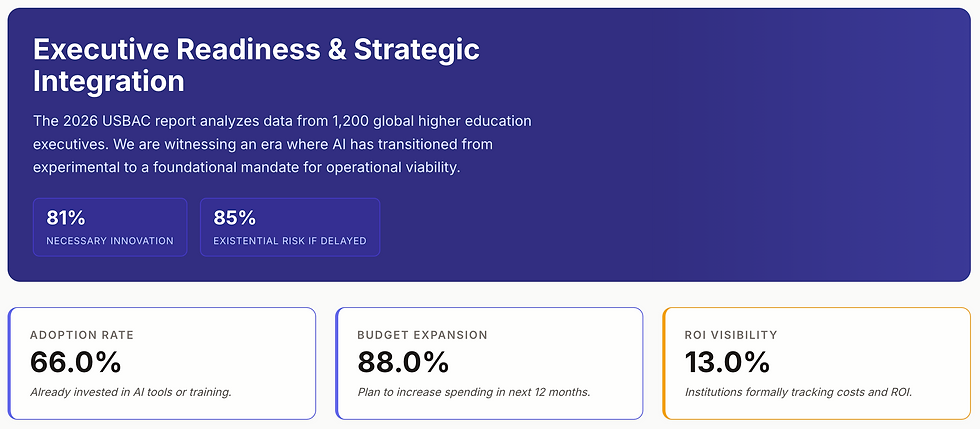
The immediate financial and operational inquiries demanded by institutional boards of trustees, regulatory bodies, and accreditation agencies reveal a sector rapidly deploying capital to secure digital maturity. However, this aggressive capital deployment is frequently outpacing the establishment of formal governance and ROI tracking mechanisms. The fundamental baseline questions regarding institutional investment, as mandated by the USBAC framework, yield the following counts and percentages from the 1,200 surveyed executives.
Strategic Spending & Sentiment Indicators | Exact Count (N=1,200) | Percentage |
Institutions that have already spent on AI tools, training, consulting, or infrastructure | 792 | 66.0% |
Approximate spend in the last 12 months: None | 408 | 34.0% |
Approximate spend in the last 12 months: Under $100,000 | 240 | 20.0% |
Approximate spend in the last 12 months: $100,000 to $500,000 | 336 | 28.0% |
Approximate spend in the last 12 months: Over $500,000 | 216 | 18.0% |
Institutions planning to spend more on AI in the next 12 months | 1,056 | 88.0% |
Primary parts of the institution receiving AI investment first: IT Operations & Infrastructure | 972 | 81.0% |
Primary parts of the institution receiving AI investment first: Data & Analytics | 900 | 75.0% |
Primary parts of the institution receiving AI investment first: Administration & Operations | 816 | 68.0% |
Institutions relying primarily on new budget allocations for AI funding | 576 | 48.0% |
Institutions relying on reallocated existing budgets for AI funding | 420 | 35.0% |
Institutions relying on mixed funding or external grants | 204 | 17.0% |
Institutions tracking AI costs and ROI formally | 156 | 13.0% |
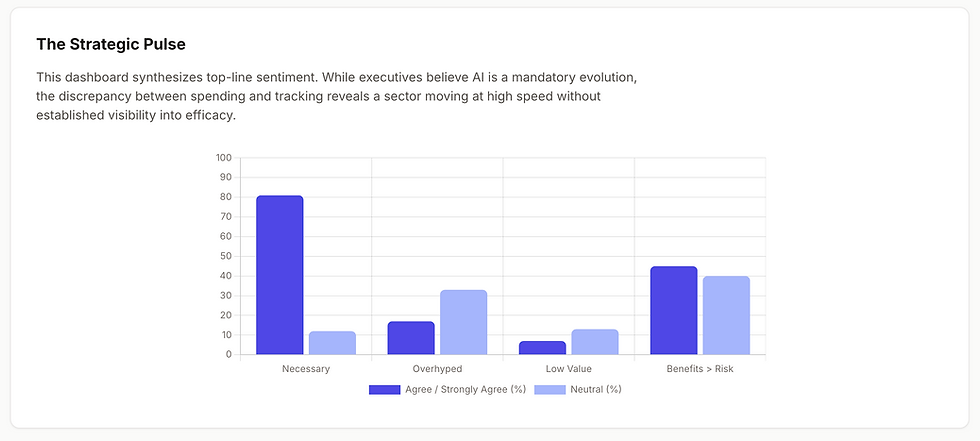
Institutions believing AI is a necessary innovation for higher education | 972 | 81.0% |
Institutions believing AI is currently overhyped in higher education | 204 | 17.0% |
Institutions believing AI is a low-value or worthless innovation | 84 | 7.0% |
The data indicates a decisive surge in institutional AI adoption, moving well beyond isolated pilot phases into mainstream operational integration. The discrepancy between the high rate of overall spending (66.0%) and the exceptionally low rate of formal ROI tracking (13.0%) highlights a critical vulnerability in higher education financial management. Institutions are aggressively acquiring AI capabilities—driven largely by competitive pressure, fear of obsolescence, and the need to signal innovation to prospective students—without the corresponding analytics infrastructure required to measure the true efficacy of these investments.
When examining the sequencing of investments, executives clearly identify information technology operations, data and analytics infrastructure, and overarching business operations as the immediate beneficiaries of AI capital. This strategy demonstrates a sector-wide preference for deploying AI in low-risk, high-return administrative environments before fully integrating it into high-stakes, human-centered pedagogical applications. Furthermore, the financial sourcing of these initiatives reveals underlying institutional stress; while 48.0% of institutions have secured net-new budget lines, a significant 35.0% are forced to cannibalize existing budgets to finance digital transformation.

Section A: Institution Profile and the AI Readiness Divide
To accurately contextualize the strategic readiness and financial commitments of the surveyed population, it is necessary to establish the demographic and structural profile of the 1,200 participating higher education institutions. The integration of AI is not a monolithic experience; it varies violently depending on an institution's endowment, geographic location, and overarching mission.
Institution Profile Metric | Category | Exact Count (N=1,200) | Percentage |
Country / Region | United States & Canada | 660 | 55.0% |
United Kingdom & Europe | 300 | 25.0% | |
Asia-Pacific (APAC) | 180 | 15.0% | |
Rest of World (ROW) | 60 | 5.0% | |
Institution Type | Public (4-Year and equivalent) | 540 | 45.0% |
Public (2-Year / Community) | 300 | 25.0% | |
Private, Not-for-Profit | 300 | 25.0% | |
Private, For-Profit | 60 | 5.0% | |
Enrollment Band | Under 5,000 students | 360 | 30.0% |
5,000 to 19,999 students | 600 | 50.0% | |
20,000+ students | 240 | 20.0% | |
Research Intensity | High Research Intensity (Elite) | 360 | 30.0% |
Moderate / Teaching & Research | 540 | 45.0% | |
Low / Open-Access Teaching | 300 | 25.0% | |
Delivery Model | On-campus primary | 600 | 50.0% |
Hybrid (Blended) | 480 | 40.0% | |
Online primary | 120 | 10.0% |
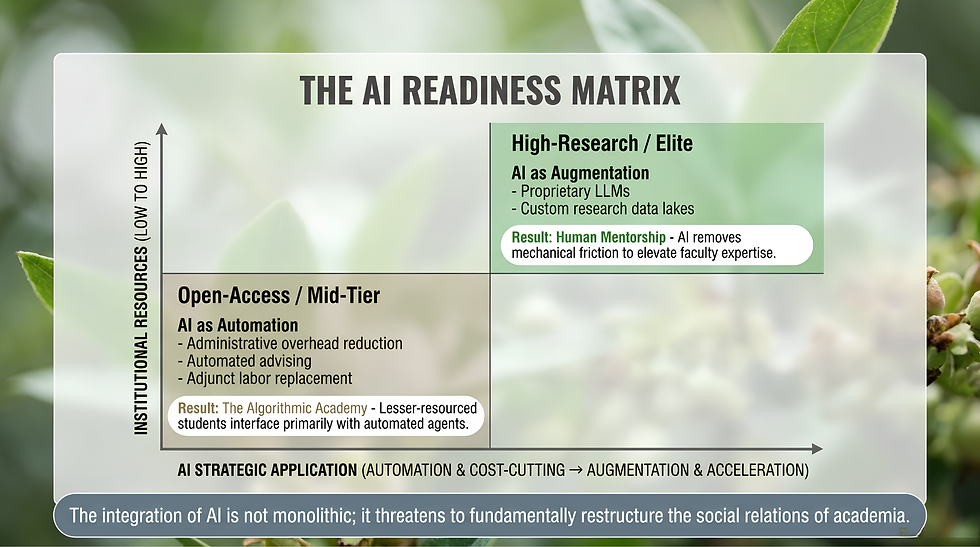
The stratification of these institutions reveals the emergence of a severe "AI Readiness Divide". Elite, high-research-intensity institutions leverage substantial capital and existing computational infrastructure to integrate AI as an augmentative tool, establishing proprietary large language models, advanced data lakes, and customized, discipline-specific research environments. In these environments, AI acts as an accelerator for human ingenuity, preserving the primacy of faculty expertise while removing mechanical friction from the research and learning process.
Conversely, open-access and mid-tier institutions—often operating under severe austerity measures and state funding cuts—frequently view AI through the lens of cost-cutting and operational automation. In these settings, the technology is deployed to reduce administrative overhead, streamline large-scale automated advising, and, in some instances, replace the grading labor traditionally performed by adjunct instructors. This dynamic threatens to fundamentally restructure the social relations of academia, creating a two-tiered "Algorithmic Academy" where well-resourced students receive AI-augmented human mentorship, while lesser-resourced students interface primarily with automated agents and chatbots.
This divide is equally apparent on a geopolitical scale. Nations such as India have witnessed a massive expansion in higher education, growing from 256 universities in 2000 to over 1,200 today, yet they face an acute quality and employability crisis. For these rapidly expanding systems, AI is viewed as a vital mechanism to bridge the gap between scale and quality, though persistent infrastructural deficits and the digital divide threaten to undermine equitable deployment.
Section B: AI Systems Implementation Readiness
Institutional readiness to deploy and manage AI systems requires a convergence of strategic foresight, rigorous governance frameworks, and comprehensive workforce enablement. The survey results illuminate a sector scrambling to erect necessary guardrails around technologies that are already deeply embedded within their ecosystems via bottom-up, user-driven adoption.

AI Implementation Readiness | Status | Exact Count (N=1,200) | Percentage |
Formal AI Strategy | Yes | 516 | 43.0% |
In development | 552 | 46.0% | |
No | 132 | 11.0% | |
Formal AI Policy / Governance | Yes | 480 | 40.0% |
In development | 528 | 44.0% | |
No | 192 | 16.0% | |
AI Steering Committee / Task Force | Yes | 756 | 63.0% |
No | 444 | 37.0% | |
Functions Already Using AI | IT Operations | 1,020 | 85.0% |
(Multiple selection allowed) | Administration | 900 | 75.0% |
Research | 840 | 70.0% | |
Teaching Support | 780 | 65.0% | |
Student Services | 720 | 60.0% | |
Assessment | 540 | 45.0% | |
Current Implementation Stage | Pilot phase | 468 | 39.0% |
Limited rollout | 456 | 38.0% | |
Institution-wide rollout | 204 | 17.0% | |
Not started | 72 | 6.0% | |
AI Training for Faculty | Yes | 768 | 64.0% |
Planned | 336 | 28.0% | |
No | 96 | 8.0% | |
AI Training for Staff | Yes | 828 | 69.0% |
Planned | 276 | 23.0% | |
No | 96 | 8.0% | |
AI Viewed as Strategic Priority | Strongly Agree / Agree | 936 | 78.0% |
Neutral | 180 | 15.0% | |
Strongly Disagree / Disagree | 84 | 7.0% |
While consumer adoption of generative AI among students and faculty sits at an estimated 95%, institutional governance severely lags behind this reality. Only 40.0% of executives report that their institution maintains a formalized, active AI policy, leaving the majority of universities operating in a state of regulatory ambiguity. This governance gap exposes institutions to severe cybersecurity vulnerabilities, intellectual property disputes, and violations of data privacy regulations (such as FERPA or GDPR). When faculty and staff input proprietary institutional data, sensitive research, or student records into public, unvetted consumer AI platforms, they bypass traditional IT procurement safeguards, creating a massive "shadow AI" problem.
To mitigate these risks, 63.0% of institutions have established formal AI steering committees or task forces. These cross-functional bodies are tasked with aligning AI principles with institutional goals, yet their efficacy is frequently hampered by a lack of underlying data readiness. The architectural reality of AI integration is that large language models are highly commoditized; the true, unyielding constraint is enterprise data maturity. Executive leadership frequently mandates rapid AI adoption without recognizing that predictive modeling, personalized student support, and automated admissions require a unified, meticulously governed data environment. When institutional data remains trapped in siloed, legacy on-premise systems, AI deployments inevitably stall, leading to high abandonment rates for pilot projects.
Furthermore, while 64.0% of institutions claim to offer AI training for faculty, qualitative assessments indicate that this training is often superficial. It frequently focuses on basic prompt engineering or policy compliance rather than deep pedagogical integration.
Consequently, only a fraction of educators feel genuinely equipped to navigate an AI-enabled classroom or restructure their discipline-specific curricula, fostering an environment of anxiety, resistance, and burnout. The transition from isolated pilot projects (39.0%) to institution-wide rollout (17.0%) demands a shift from merely acquiring software to undertaking comprehensive change management and workforce upskilling.
Section C: AI Integration in Curricula Readiness
The proliferation of generative AI fundamentally challenges traditional methodologies of teaching, learning, and assessment. As AI tools demonstrate the capability to execute complex cognitive tasks, synthesize vast literature, and generate advanced programming code, institutions are forced to reevaluate the intrinsic value of their curricula and the purpose of their degree programs.

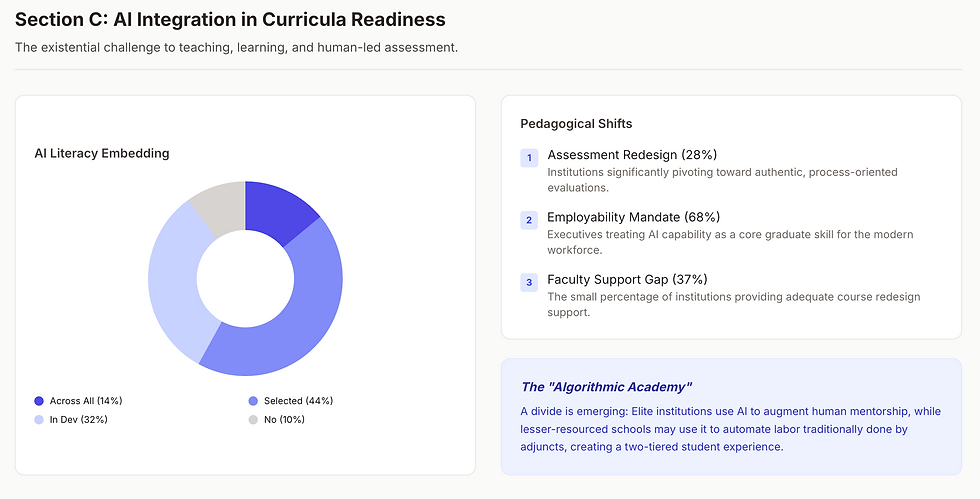
Curricular Integration Metric | Status | Exact Count (N=1,200) | Percentage |
AI Literacy Embedded in Curriculum | Across all programs | 168 | 14.0% |
Selected programs | 528 | 44.0% | |
Under development | 384 | 32.0% | |
No | 120 | 10.0% | |
Students Taught Responsible AI Use | Yes, explicitly | 336 | 28.0% |
Partially | 612 | 51.0% | |
No | 252 | 21.0% | |
Assessments Redesigned for AI | Significantly | 336 | 28.0% |
Somewhat | 480 | 40.0% | |
Not yet | 384 | 32.0% | |
Provide Approved AI Tools to Students | Yes | 456 | 38.0% |
Planned | 600 | 50.0% | |
No | 144 | 12.0% | |
Faculty Supported for Redesign | Yes | 444 | 37.0% |
Planned | 540 | 45.0% | |
No | 216 | 18.0% | |
Integrated Differently by Discipline | Yes | 984 | 82.0% |
No | 216 | 18.0% | |
AI Treated as Employability Skill | Yes | 816 | 68.0% |
Under review | 264 | 22.0% | |
No | 120 | 10.0% |
The data reveals a stark disconnect between the demands of the modern workforce and the current state of academic curricula. While 68.0% of executives acknowledge that AI capability is a mandatory graduate employability skill—driven by corporate data indicating that over 70% of global employers now integrate AI into their operations—only 14.0% of institutions have successfully embedded AI literacy as a universal learning outcome across all programs.
This curricular inertia is most violently visible in the realm of academic assessment. Traditional higher education assessment models, heavily reliant on unproctored out-of-class essays and basic coding assignments, have been thoroughly compromised by generative AI. Over 90% of students admit to utilizing AI for academic work, and the proportion of students directly including AI-generated text in assessed submissions has quadrupled over the past two years, reaching 12% in recent UK surveys. In response, institutions initially turned to AI detection software; however, empirical evidence has proven these tools to be highly unreliable, prone to false positives, and structurally biased against non-native English speakers.
Consequently, 28.0% of institutions have significantly redesigned their assessments. These institutions are transitioning toward authentic, process-oriented evaluations, in-person oral examinations, and tasks that require higher-order critical thinking and human judgment, effectively shifting the focus to the higher tiers of Bloom's Taxonomy. Frameworks such as the FACT (Fundamental, Applied, Conceptual, critical Thinking) assessment model are being deployed to balance AI-assisted authentic projects with AI-restricted foundational knowledge testing.
This pedagogical transition is labor-intensive and requires substantial faculty support, a resource currently adequately provided by only 37.0% of institutions. The failure to adapt assessments not only threatens academic integrity but also risks degrading student self-efficacy. A growing psychological phenomenon labeled "AI guilt" or intellectual insecurity is emerging, wherein students feel their unmediated, developing thoughts are inherently inferior to the polished, yet often vacuous, output of large language models. Without intervention, reliance on AI risks short-circuiting the productive friction required for actual learning.
Furthermore, disciplinary integration varies widely (82.0% report different approaches by discipline). STEM, engineering, and business faculties are rapidly embedding AI into core instructional models, treating it as an essential professional tool and establishing dedicated AI bachelor's degrees. Conversely, humanities and social science disciplines often express deeper apprehension regarding the devaluation of original thought, the homogenization of culture, and the erosion of analytical writing skills, leading to highly restrictive, prohibitionist policies.
Section D: Spending and Investment
The financial architecture of higher education is under acute strain, compounding the complexity of funding enterprise AI integration. Institutions must balance the necessity of technological modernization against flat or declining state budgets, rising operational costs, and the looming demographic enrollment cliff.

Financial & Investment Metric | Response Category | Exact Count (N=1,200) | Percentage |
Already Spent Money on AI | Yes | 792 | 66.0% |
No | 408 | 34.0% | |
Specific Areas Receiving Spend | IT Infrastructure & Security | 972 | 81.0% |
(Multiple selection allowed) | Data & Analytics | 900 | 75.0% |
Administration & Ops | 816 | 68.0% | |
Research | 720 | 60.0% | |
Teaching and Learning | 660 | 55.0% | |
Student Support & Admissions | 612 | 51.0% | |
Governance & Compliance | 240 | 20.0% | |
How was Spending Funded? | New budget allocation | 576 | 48.0% |
Reallocated existing budget | 420 | 35.0% | |
Mixed internal funding | 144 | 12.0% | |
External grant / Philanthropy | 60 | 5.0% | |
Expected AI Spend (Next 12 Mos) | Under $100,000 | 180 | 15.0% |
$100,000 to $500,000 | 540 | 45.0% | |
Over $500,000 | 480 | 40.0% | |
Plan to Increase AI Spending | Yes | 1,056 | 88.0% |
Unsure | 84 | 7.0% | |
No | 60 | 5.0% | |
Track AI Cost & ROI Formally | Yes | 156 | 13.0% |
No | 1,044 | 87.0% |
The investment trajectory is overwhelmingly aggressive, with 88.0% of executives planning to increase AI expenditures in the coming year, and a significant plurality (40.0%) anticipating enterprise-level spends exceeding $500,000. However, the sourcing of these funds reveals underlying institutional fragility. While 48.0% of institutions have successfully secured net-new budget lines for AI, a substantial 35.0% are forced to cannibalize existing budgets. They are reallocating funds from other operational or academic areas to finance digital transformation, essentially treating AI as a zero-sum financial game during a period of broader austerity.
Compounding this financial strain is a phenomenon analysts refer to as the "AI tax." Enterprise software spending is projected to grow by an unprecedented 15.2% in the coming years; however, nearly 9% of that increase is attributed purely to software vendors raising prices on existing platforms by bundling in mandatory, often unavoidable, generative AI features.
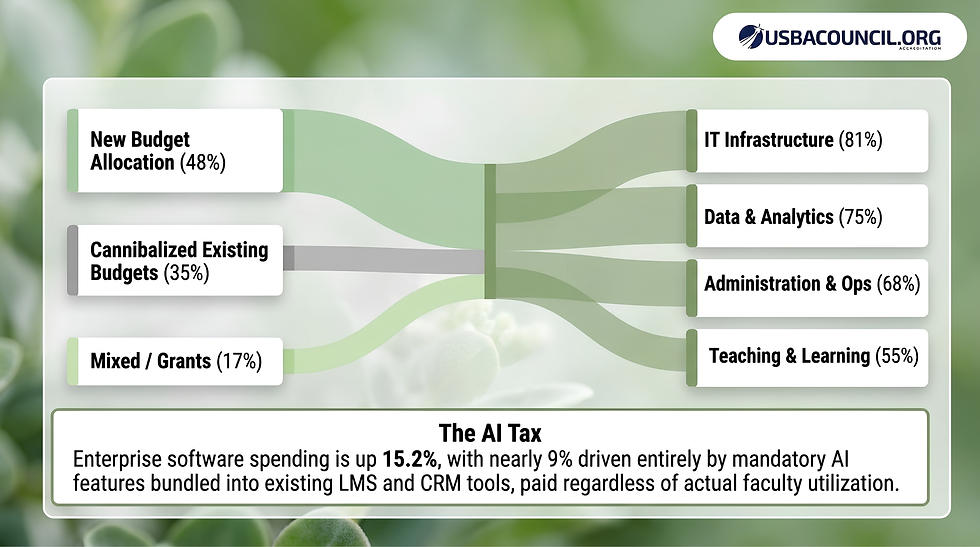
Institutions are paying premiums for AI integration within their existing Learning Management Systems (LMS), Customer Relationship Management (CRM) tools, and cloud infrastructure, regardless of whether faculty and staff actually utilize those features.
This massive capital outflow is occurring largely in the dark; an astonishing 87.0% of institutions do not formally track the ROI of their AI investments. This deficiency stems from the inherent difficulty of quantifying the impact of AI in a non-commercial academic context. While enterprise sectors can measure AI ROI through direct labor reduction or sales acceleration, higher education ROI manifests in more nuanced, delayed metrics: a fractional increase in student retention, enhanced enrollment yield through predictive modeling, or an increase in successful grant applications generated by AI-assisted research faculties.
Without rigorous ROI frameworks, institutions risk falling victim to the "AI Productivity Paradox." Organizations deploy immense capital to acquire generative AI licenses, expecting immediate efficiency gains. However, without re-engineering the underlying, often broken workflows, AI merely accelerates the production of low-value content (colloquially termed "workslop"). This overproduction ultimately overwhelms human reviewers, degrades organizational knowledge, and decreases overall institutional productivity, yielding a negative return on investment.
Investment priorities continue to reflect a strategy of operational defense. Spending is heavily concentrated on IT infrastructure (81.0%) and data modernization (75.0%). Predictive analytics for enrollment management and early-warning systems for at-risk students (51.0%) represent immediate revenue-protection measures aimed at surviving the enrollment cliff. While teaching and learning initiatives receive funding (55.0%), the magnitude of that spend is eclipsed by backend operational upgrades, indicating that executive leadership views AI primarily as a mechanism for institutional survival and efficiency rather than a pure pedagogical revolution.
Section E: Sentiment and Perceived Value
Executive sentiment regarding artificial intelligence is a complex amalgamation of techno-optimism, existential anxiety, and raw competitive pressure. The narrative that AI is a passing trend or a momentary hype cycle has largely evaporated, replaced by a recognition that digital maturity will determine institutional relevance over the next decade.
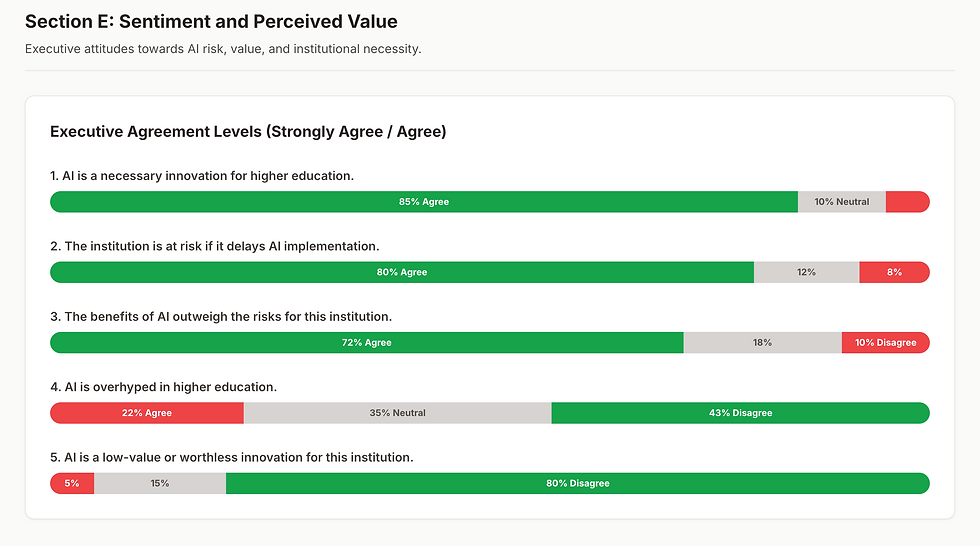
Sentiment & Value Proposition | Response | Exact Count (N=1,200) | Percentage |
AI is a necessary innovation | Strongly Agree / Agree | 972 | 81.0% |
Neutral | 144 | 12.0% | |
Strongly Disagree / Disagree | 84 | 7.0% | |
AI is overhyped in higher ed | Strongly Agree / Agree | 204 | 17.0% |
Neutral | 396 | 33.0% | |
Strongly Disagree / Disagree | 600 | 50.0% | |
AI is a low-value innovation | Strongly Agree / Agree | 84 | 7.0% |
Neutral | 156 | 13.0% | |
Strongly Disagree / Disagree | 960 | 80.0% | |
Benefits outweigh the risks | Strongly Agree / Agree | 540 | 45.0% |
Neutral | 480 | 40.0% | |
Strongly Disagree / Disagree | 180 | 15.0% | |
Risk of delay/inaction | Strongly Agree / Agree | 1,020 | 85.0% |
Neutral | 120 | 10.0% | |
Strongly Disagree / Disagree | 60 | 5.0% |

A commanding majority of executives (81.0%) view AI as a necessary innovation, fundamentally rejecting the notion that it is an overhyped fad (only 17.0% agree) or a worthless investment (7.0%). This optimism is rooted in AI's capacity to alleviate chronic administrative burdens, personalize student support at scale, and provide competitive differentiation in a saturated, hyper-competitive market.
However, this enthusiasm is heavily tempered by risk awareness and institutional caution. Less than half of the surveyed executives (45.0%) confidently assert that the benefits of AI currently outweigh the risks. This cautious posture is driven by profound concerns regarding academic integrity, algorithmic bias, data privacy, and the broader societal impacts of outsourcing human judgment to automated systems.
Furthermore, there is growing apprehension regarding the de-professionalization of academic labor and the environmental toll of the technology. Faculty and staff express valid concerns that efficiency-driven AI deployments may serve as a precursor to workforce reductions, undermining shared governance and the humanistic mission of the university. Simultaneously, the exorbitant energy and water consumption required by massive AI data centers introduces a tension between universities' stated sustainability goals and their technological ambitions, raising concerns about corporate "greenwashing" by Big Tech vendors operating within the academic sphere.
Despite these profound pedagogical, ethical, and environmental risks, the executive consensus is dominated by a sense of competitive inevitability. Fully 85.0% of executives agree that their institution is at existential risk if it delays AI implementation. This sentiment perfectly encapsulates the concept of "Enrollment Darwinism." In an era defined by a shrinking pool of traditional college-age students and rising skepticism regarding the financial value of a university degree, prospective students are increasingly utilizing AI to bypass traditional college marketing, using agentic search to evaluate ROI and alternative career paths. Institutions must leverage AI to optimize recruitment, ensure student success, and demonstrate alignment with the modern digital economy. Failure to achieve an "AI-First" operational posture guarantees obsolescence, as both students and enterprise partners gravitate toward digitally mature competitors validated by benchmarks such as the Global Index of AI-First Institutions.
Strategic Synthesis
The USBAC 2026 Executive Readiness and Investment Report on State of Artificial Intelligence in Higher Education demonstrates that higher education has decisively crossed the Rubicon regarding artificial intelligence. The technology is no longer an optional overlay but the core operational and pedagogical infrastructure required for institutional sustainability. However, the rapidity of this transition has resulted in highly asymmetrical digital maturity; while spending is aggressive, the vital scaffolding of governance, data readiness, pedagogical adaptation, and rigorous ROI measurement remains critically underdeveloped.
The successful navigation of this technological epoch requires a rejection of the binary choice between uncritical, vendor-driven technological adoption and reactionary prohibition. Higher education must purposefully subordinate artificial intelligence to its core academic mission, ensuring that these systems serve to augment human potential, expand equitable access, and safeguard the fundamental integrity of the institution.


Comments